
The short answer
Choose a tyre by its complete specification and the work the vehicle actually does, not by the letters alone. Passenger tyres are commonly used where everyday road comfort and lighter vehicle duty are the priority. LT, or light-truck, tyres are designed for commercial-vehicle and heavier-load applications, but the correct choice still depends on the vehicle placard, load index, speed rating, size, construction and approved fitment.
An LT tyre is not automatically the best upgrade for every ute or 4WD. It may provide the load capability needed for towing, tools, cargo or demanding off-road work, but can also change ride, weight and pressure requirements. Equally, a passenger-construction tyre is not suitable simply because its nominal size fits the wheel. The required load and speed ratings must be met, and a qualified tyre professional should confirm the final fitment.
This follows our guide to whether budget tyres are safe in Australia. Price is only one part of value. Correct construction and load capability come first.
What do P and LT markings mean?
Tyre sidewalls combine several pieces of information. A size may begin with P, meaning passenger-car tyre under that sizing system, or LT, meaning light-truck tyre. Some metric sizes have no leading letter, while commercial van sizes may use a C marking. The full marking, including load index and speed symbol, matters more than any one letter in isolation.
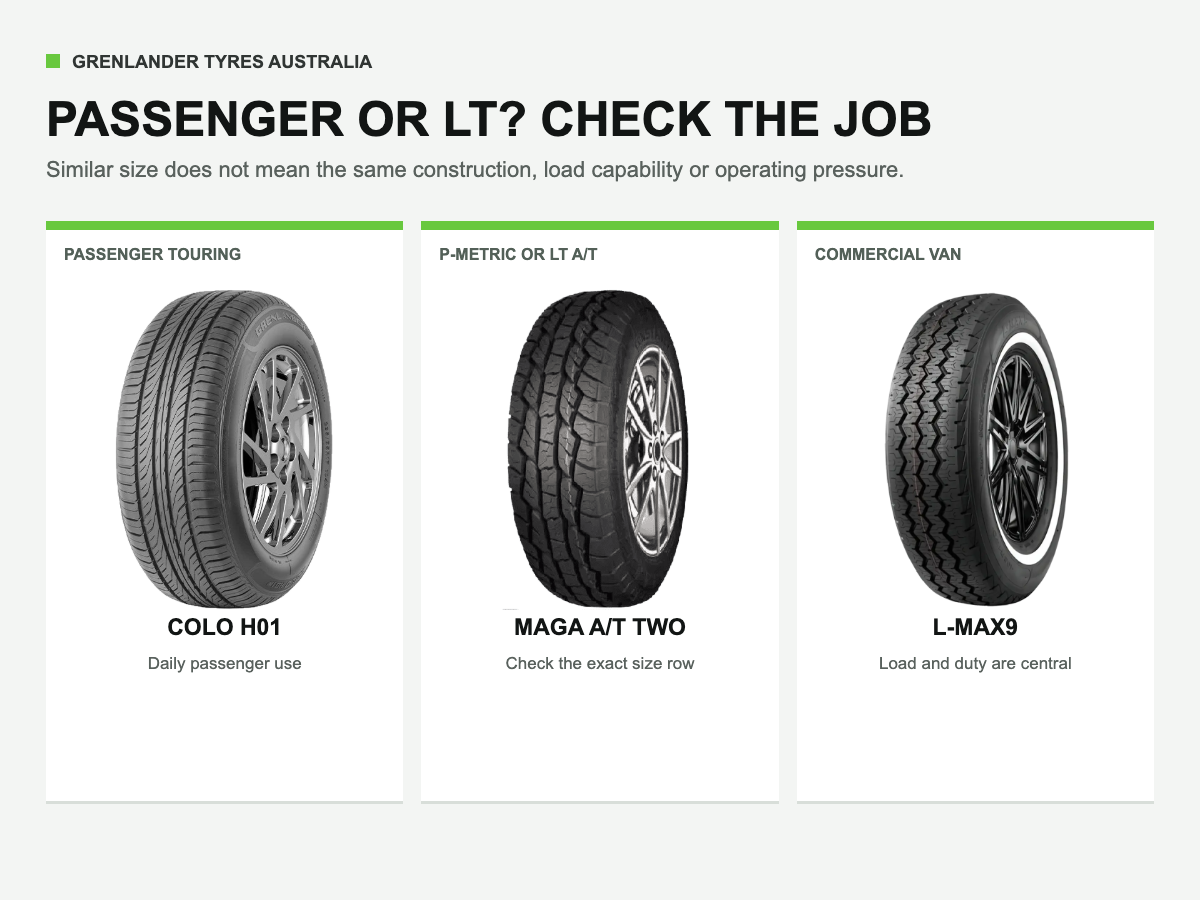
Two tyres with similar width, aspect ratio and rim diameter may still have different load capacities, constructions and inflation requirements. That is why a same-size visual match is not enough.
| Check | Passenger-oriented fitment | LT or commercial fitment |
|---|---|---|
| Typical duty | Everyday passenger and lighter SUV use | Utes, vans, heavier loads and demanding mixed-road work |
| Load capability | Determined by the exact load index | Often offered with higher load capability, depending on size and specification |
| Pressure | Follow the vehicle and tyre requirements | May require different operating pressure for the actual load |
| Ride and weight | Often selected with road comfort in mind | Heavier construction can change ride and steering response |
| Correct decision | Placard, full sidewall code and real use | Placard, axle loads, towing or cargo duty and professional confirmation |
These are general distinctions, not a substitute for checking the exact tyre specification.
Start with the vehicle placard
Australian vehicle rules and guidance treat the tyre placard as the starting point. It records the manufacturer's nominated tyre sizes and recommended pressures, and replacement tyres must meet applicable load and speed requirements. The National Code of Practice for Light Vehicle Construction and Modification states that replacement tyre load rating must not be below the lowest rating listed on the placard or an equivalent vehicle variant.
Before comparing brands or patterns, photograph the placard and record:
- the complete tyre size;
- the load index;
- the speed rating;
- the recommended cold pressures; and
- any different requirements for loaded operation.
If the vehicle has a GVM upgrade, suspension modification, non-standard wheels or a changed tyre diameter, the calculation can be more involved. Confirm the approved specification rather than relying on the tyre currently fitted.
When an LT tyre may be relevant
An LT option becomes worth investigating when a vehicle repeatedly carries tools or cargo, tows close to its approved limits, travels remotely, or faces rough surfaces where the selected construction and load specification are appropriate. The operative word is repeatedly. An aggressive-looking sidewall is not evidence that the tyre is the right fit.
For towing, include the vehicle's real loaded condition, passengers, accessories, luggage, tow-ball load and axle limits. The tyre must have enough capacity for the load carried by each axle, not merely the vehicle's empty weight.
The Australian Government code requires replacement tyre load capacity to be checked against the vehicle's requirements. The same nominal size may be available with different load indices, so the number must be checked on the exact tyre.
When a passenger tyre may still be the better fit
Many dual-cab utes and SUVs spend most of their lives on suburban roads and highways, carry modest loads and operate within the manufacturer's original specification. In that situation, an approved passenger or SUV fitment may provide a more suitable balance for daily use than moving to an LT construction without a clear load or duty reason.
The decision should account for ride priorities, steering response, fuel use, tyre weight, available sizes and replacement support. None of those outcomes can be assumed from the P or LT marking alone; compare the exact model and size.
Grenlander examples: compare the specification, not just the tread
Grenlander's Australian range illustrates why category and construction are separate decisions.
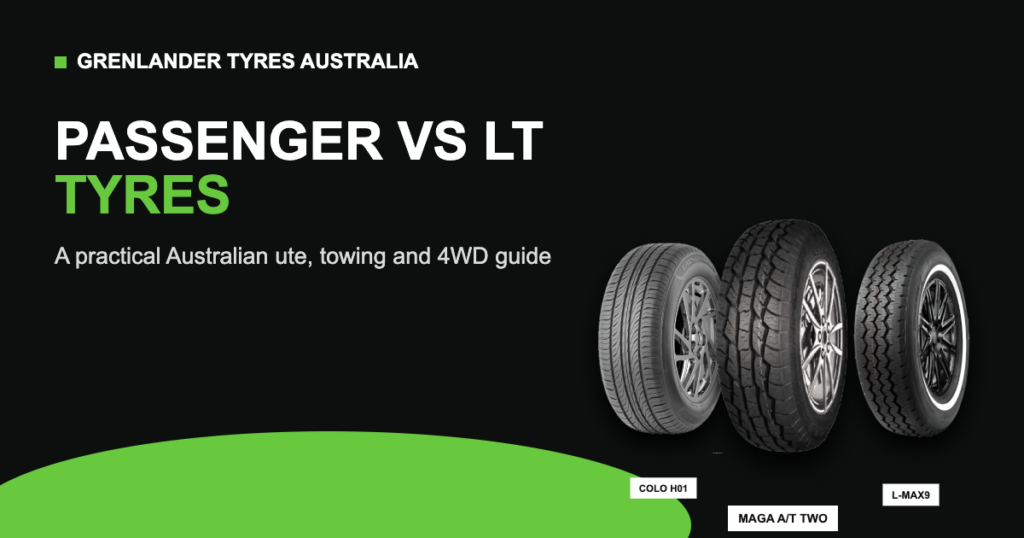
COLO H01: passenger touring
COLO H01 is listed as a passenger touring pattern. It is a relevant starting point for everyday passenger applications where the exact size, load index and speed rating match the vehicle.
MAGA A/T TWO: mixed-road sizes including passenger and LT specifications
MAGA A/T TWO is an all-terrain pattern with both passenger and LT specifications in the manufacturer's range. This is a useful reminder that the tread category, A/T, does not by itself tell you the construction or load capability. Buyers must inspect the full size row for the exact version under consideration.
L-MAX9: commercial van duty
L-MAX9 is listed as a commercial van pattern and includes C-marked sizes. A commercial product should be assessed against the van's axle load, placard, pressure and daily duty rather than compared with passenger tyres on nominal size alone.
The manufacturer range is broader than local warehouse stock. Confirm the exact Australian availability before recommending a model or promising future single-tyre replacement.
Keep three decisions separate at the service desk
| Decision | What the shop records |
|---|---|
| Construction and size markings | The complete requested size and relevant P, LT, C or other markings. Do not replace the full specification with a category name. |
| Tread and operating use | The customer’s road mix and the proposed pattern’s documented use. An A/T or M/T label alone does not establish LT construction. |
| Exact load and speed specification | The service description for the selected size, single/dual configuration where relevant, and the vehicle requirements checked by the workshop. |
A tyre with a higher load rating does not itself increase the vehicle’s permitted axle loads. Michelin’s load-rating explanation distinguishes tyre capacity from the vehicle’s own axle limits. Keep vehicle approvals and any modifications with the job record.
Record the customer’s answers once
Add a short note to the job: vehicle and modification details; placard or approved specification reference; usual load and towing use; sealed-road and unsealed-road use; requested product; and unresolved questions. Record who checked the final specification and when. The buyer can then quote the approved line without turning the customer’s road-use description into an assumed fitment.
If the request is simply “an LT all-terrain”, ask which full size and ratings have been verified, what the vehicle carries and how it is used. Keep an unanswered technical question pending rather than approving a product from those two labels.
Use the load index and speed rating guide to read the codes, then carry the approved specification into the wholesale enquiry worksheet.
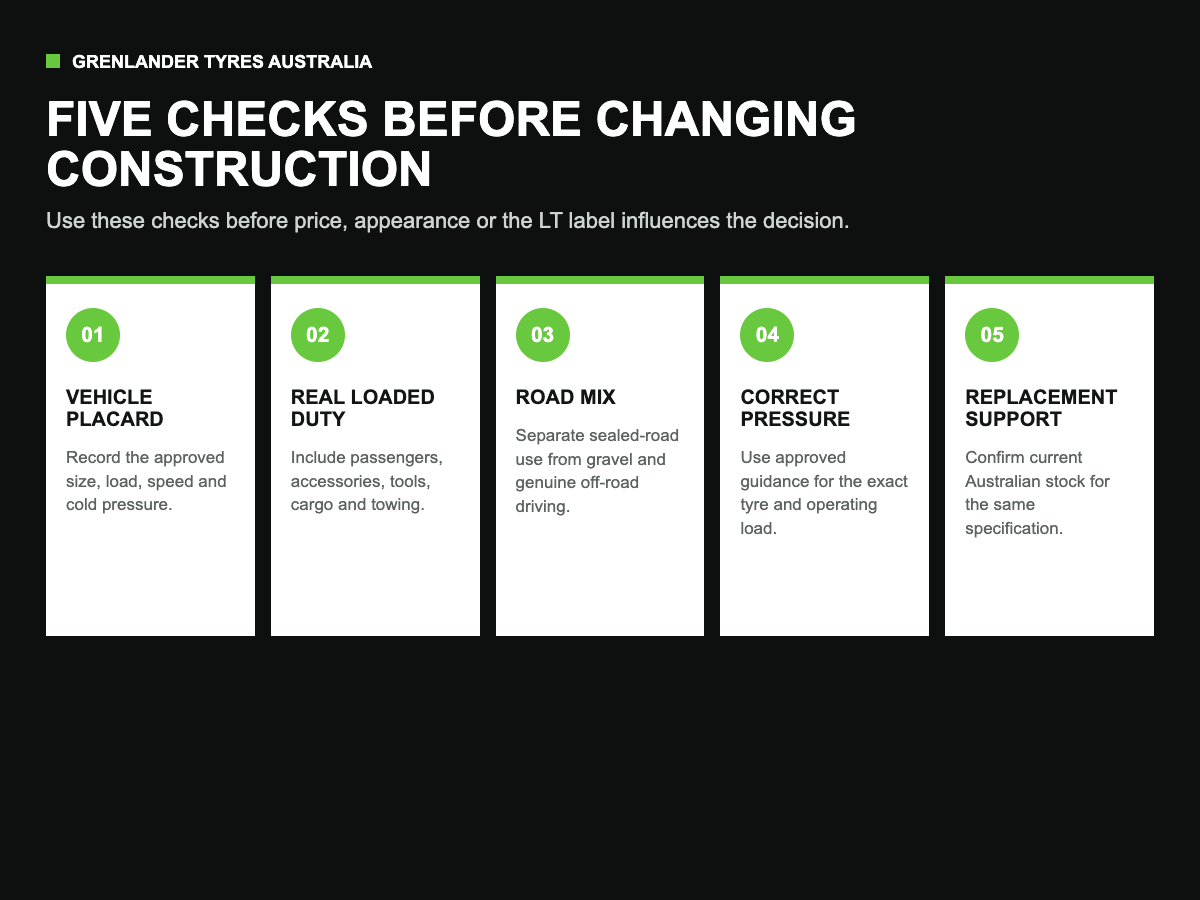
Five questions before changing construction
1. What does the placard require?
Use the placard as the baseline for size, load, speed and pressure. If current tyres differ, establish why before copying that fitment.
2. What is the vehicle's real loaded duty?
List passengers, accessories, tools, cargo and towing. Occasional camping gear and daily trade loads are different use cases.
3. How much driving is on sealed roads?
Construction and tread category are separate. First decide whether H/T, A/T, R/T or M/T matches the road mix, then compare passenger and LT versions where available.
4. What pressure does the exact tyre require?
Do not copy a pressure from another vehicle or assume an LT tyre should always be inflated to its sidewall maximum. Use approved vehicle and tyre guidance for the load and operating conditions.
5. Can the same specification be replaced locally?
Check present stock and likely replacement support. A single damaged tyre should not force an avoidable change of specification across an axle.
Common mistakes to avoid
- Choosing LT because it sounds stronger without checking whether the vehicle needs it.
- Comparing tyres by diameter and width while ignoring load index and speed rating.
- Treating ply rating as a literal count of physical plies or as a complete measure of suitability.
- Assuming an all-terrain tyre is automatically LT construction.
- Using the maximum pressure printed on a tyre as the everyday target.
- Forgetting that towing and cargo can change axle loads.
- Assuming every manufacturer-listed size is stocked in Australia.
Frequently asked questions
Are LT tyres safer for towing?
Safety depends on the complete approved fitment, correct load capacity, pressure, condition and operation. An LT tyre may be relevant where its specification matches the towing duty, but the LT marking alone does not prove that it is safer for a particular vehicle.
Do LT tyres last longer?
There is no universal answer. Wear depends on the exact model, size, pressure, load, alignment, rotation, road surface and driving. Compare evidence for the specific tyres rather than assuming construction guarantees mileage.
Can I replace an LT tyre with a passenger tyre?
Do not make that substitution from nominal size alone. The replacement must satisfy applicable vehicle, placard, load, speed and construction requirements. Seek professional confirmation, especially for load-carrying or modified vehicles.
Does every all-terrain tyre have LT construction?
No. Some A/T patterns are offered in passenger and LT specifications. Check the complete sidewall marking and product size table.
Which Grenlander tyre suits a ute?
There is no single ute answer. The correct category depends on sealed-road use, gravel or off-road demand, load, towing and the approved fitment. MAGA A/T TWO is one mixed-road example with passenger and LT sizes; suitability and stock must be confirmed for the exact vehicle.
Related guides
- Are Budget Tyres Safe in Australia?
- All-Terrain vs Highway-Terrain Tyres
- Are Grenlander Tyres Good? Australian guide
- Grenlander Australian tyre range
- Contact Grenlander Australia
Fact-check sources
- Australian Government National Code of Practice, Section LS
- Grenlander product pages linked in each model section