
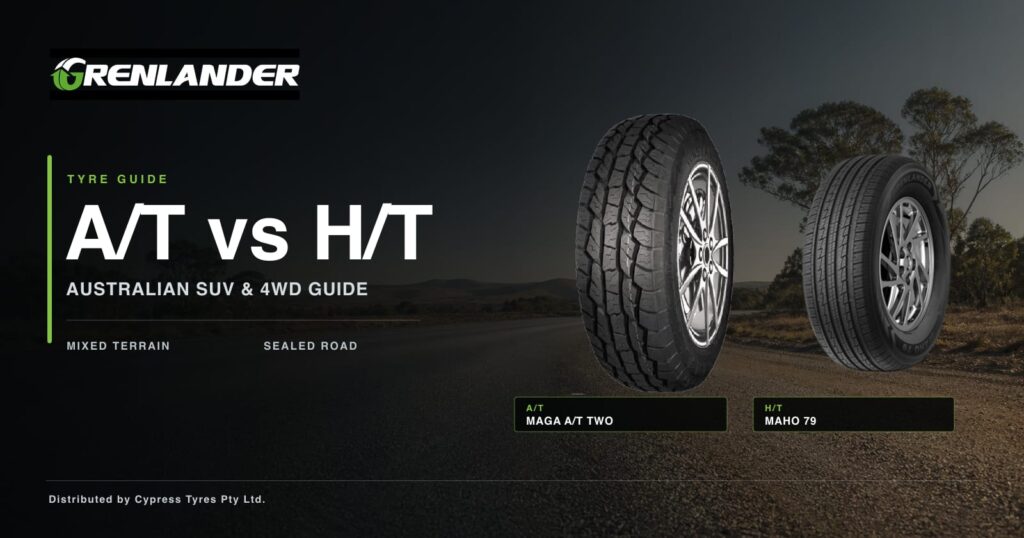
If your SUV or 4WD spends nearly all its time on sealed roads, a highway-terrain (H/T) tyre will usually be the more road-focused choice. If you regularly combine highway driving with gravel roads, work sites or touring tracks, an all-terrain (A/T) tyre may provide a better balance. The label alone is not enough, however: the exact pattern, size, load rating, speed symbol and vehicle fitment still need to be checked.
Choosing between all-terrain and highway-terrain tyres is therefore less about which category is “better” and more about where the vehicle genuinely spends its time.
A/T vs H/T tyres: the quick comparison
| Consideration | Highway-Terrain (H/T) | All-Terrain (A/T) |
|---|---|---|
| Main design priority | Sealed-road driving | Mixed sealed and unsealed driving |
| Daily commuting | Usually the more road-focused option | Suitable, but the result varies by pattern |
| Gravel and maintained dirt roads | Light or occasional use | Generally better suited to regular use |
| Tread appearance | Closer blocks and road-oriented ribs | More open blocks and shoulder voids |
| Road noise | Typically lower, depending on the pattern | May be more noticeable |
| Mud and deep ruts | Limited | More capable than H/T, but not a substitute for M/T |
| Touring and work-site use | Best when off-road exposure is limited | Often the more versatile category |
These are category-level tendencies, not performance guarantees. Two tyres carrying the same A/T or H/T label can behave differently because of their tread design, compound, construction and size.
What is a highway-terrain tyre?
A highway-terrain tyre is designed primarily for sealed-road use on SUVs, crossovers and 4WDs. Compared with a more aggressive off-road pattern, an H/T tyre usually places more rubber in contact with the road and uses smaller tread voids.
That road-focused design commonly aims to support:
- everyday commuting and motorway travel;
- predictable on-road handling;
- lower pattern noise;
- comfortable long-distance touring; and
- water evacuation through longitudinal grooves and sipes.
For example, the Grenlander MAHO 79 is classified as an SUV H/T pattern. Its product page describes four main drainage grooves, multiple sipes and a comparatively closed shoulder design intended to support wet-road drainage, steering stability and road comfort.
Those design statements apply to that pattern; they should not be treated as proof that every H/T tyre performs identically, or that an H/T label alone determines wet braking or tyre life.
What is an all-terrain tyre?
An all-terrain tyre is intended to cover a broader mix of sealed and unsealed surfaces. A/T patterns typically use more open tread blocks, larger shoulder features and wider channels than an H/T tyre.
Depending on the exact model, that can help the tyre deal with:
- gravel roads;
- compact dirt;
- touring routes;
- work-site access;
- shallow ruts; and
- light to moderate off-road use.
The trade-off is that a more open pattern can introduce additional road noise, weight or rolling resistance. How noticeable that becomes depends on the vehicle, tyre size, pressure, load, road surface and the individual tread pattern.
Grenlander currently lists two relevant examples:
- The MAGA A/T TWO uses an open all-terrain pattern with stone-ejection features and is listed in passenger-style, commercial and LT fitments.
- The STEADTREK AT is positioned as a balanced SUV and 4×4 all-terrain pattern, with many of its listed fitments using LT construction.
Manufacturer-range listings do not guarantee that every size is held in Australian stock. Confirm the exact pattern, size and current availability before purchase.
Which tyre suits the way you drive?
Mostly city streets and motorways
If more than 90% of your driving is on sealed roads and your unsealed-road use is limited to well-maintained access roads, an H/T tyre will often be the more logical starting point.
That is particularly relevant for family SUVs and crossovers used for commuting, school runs and long motorway trips. There is little value in accepting a more aggressive pattern if its additional off-road capability is rarely used.
Sealed roads plus regular gravel
An A/T tyre becomes more relevant when gravel, corrugations and unsealed roads are a routine part of the journey rather than a once-a-year exception.
This may apply to regional drivers, touring vehicles, tradespeople and owners who regularly access campgrounds or rural properties. A road-oriented A/T pattern can provide a useful middle ground without moving directly to an aggressive mud-terrain design.
Work sites and loaded touring
For work vehicles and loaded touring 4WDs, tread type is only one part of the decision. Construction, load index, speed symbol and inflation requirements matter just as much.
Some A/T sizes are available in LT construction, but A/T and LT do not mean the same thing:
- A/T describes the intended terrain category.
- LT identifies a Light Truck-type size or construction designation.
Do not assume that towing automatically requires an LT tyre, or that every LT tyre is appropriate for a particular vehicle. The fitted tyre must satisfy the vehicle manufacturer’s requirements and be suitable for the wheel and operating load.
Frequent mud and technical tracks
An A/T tyre is not automatically the right choice for deep mud, large rock steps or repeated low-range technical driving. Drivers who regularly encounter those conditions may need to compare rugged-terrain and mud-terrain patterns as well.
The more aggressive the tread becomes, the more important it is to consider sealed-road noise, wet-road behaviour, rotating mass and everyday comfort.
What about wet roads?
It is too simplistic to say that every H/T tyre is good in the wet or every A/T tyre is poor in the wet. Wet-road performance depends on the complete pattern and compound, not only the category printed in a product catalogue.
When comparing two actual tyres, look at:
- drainage groove design;
- siping;
- the exact load and speed specification;
- available tyre-label or independent test data, where applicable;
- tread condition and age; and
- correct pressure for the vehicle and load.
Drive to the conditions and allow appropriate braking distance regardless of the tread category.
Will A/T tyres use more fuel or wear faster?
A more open and heavier tyre can affect rolling resistance and fuel use, but the result cannot be predicted from the A/T label alone. Tyre size, construction, pressure, alignment, vehicle load and driving style all influence fuel consumption and wear.
Moving to a larger diameter or heavier LT fitment may have a more noticeable effect than changing between two patterns of the same size. That is why fitment decisions should be based on the complete specification rather than appearance.
Grenlander H/T and A/T examples
| Pattern | Category | Best used as an example of |
|---|---|---|
| MAHO 79 | SUV H/T | Road-focused SUV fitments and sealed-road touring |
| MAHO77 | SUV H/T | Another H/T option to compare by exact size |
| MAGA A/T TWO | SUV A/T | Open all-terrain tread and mixed fitment types |
| STEADTREK AT | SUV A/T | A/T touring and listed LT fitments |
This table explains product positioning; it is not a head-to-head performance test. Use the live specification tables to compare the exact sizes available for your vehicle.
Five checks before choosing A/T or H/T tyres
- Be honest about your driving split. Estimate the percentage of sealed road, gravel and off-road use.
- Read the vehicle tyre placard. Confirm the original size and minimum load and speed requirements.
- Check the exact specification. A pattern name can cover multiple sizes with different ratings and constructions.
- Consider the whole vehicle setup. Load, towing, wheel width, suspension clearance and tyre pressure all matter.
- Ask a qualified tyre professional. This is especially important when changing tyre size or construction.
Frequently asked questions
Are all-terrain tyres worth it if I mostly drive on-road?
If almost all your driving is on sealed roads, an H/T tyre may provide a more appropriate road-focused result. An A/T tyre becomes easier to justify when gravel roads, touring tracks or work-site access are regular parts of your use. Choose for your normal driving, not a hypothetical once-a-year trip.
Are A/T tyres noisier than H/T tyres?
An A/T pattern can produce more road noise because of its larger blocks and wider voids, but the amount varies significantly between models, sizes, vehicles and road surfaces. Compare the actual patterns being considered rather than assuming every A/T tyre will have the same noise level.
Can highway-terrain tyres be used on gravel roads?
H/T tyres can handle maintained gravel and unsealed access roads when driven appropriately, but they are designed mainly for sealed-road use. If gravel, corrugations or rough access roads form a regular part of the journey, an A/T pattern may be more suitable.
Do I need LT tyres for towing?
Not automatically. The tyre must meet the vehicle manufacturer’s requirements and carry the operating load at an appropriate pressure. LT construction may suit some towing or work applications, but load index, wheel compatibility, ride, weight and the complete vehicle setup must be considered.
Are all-terrain tyres suitable for daily driving?
Yes, many A/T tyres are designed for mixed daily and touring use. The trade-offs can include additional noise, weight or rolling resistance compared with a road-focused H/T tyre. The right balance depends on the exact pattern and how often its off-road capability is needed.
What is the difference between A/T and M/T tyres?
A/T tyres aim to balance sealed-road and off-road use. M/T tyres use a more aggressive design intended for mud, ruts and technical terrain. A dedicated M/T will generally introduce greater on-road compromises, so it should be chosen for genuine off-road need rather than appearance.
Explore the Grenlander range
The right tyre begins with the vehicle placard, the actual driving environment and the exact size—not the category name alone.
Explore the Grenlander tyre range to compare H/T and A/T patterns by vehicle category, tread type and size. For availability and fitment guidance, contact a tyre professional or our team.