
The short answer
Budget tyres can make practical sense in Australia, but price, brand and tread style do not make any tyre “safe” on their own. What matters is whether the tyre is approved for road use, matches the vehicle’s required size, load index and speed rating, suits the conditions in which it will be driven, and is fitted and maintained correctly. When a budget tyre meets those checks, it may be a better buy than paying for capabilities you do not need.
What does “budget tyre” actually mean?
In most cases, “budget” describes where a tyre sits in the market rather than a separate legal or technical category. The lower price may come from a simpler range, lower marketing costs, different distribution economics, fewer premium refinements or a design aimed at mainstream use instead of maximum performance.
That distinction is worth keeping in mind. Two tyres with the same size on the sidewall may still be built for very different jobs. One may favour quiet suburban touring, another commercial load duty, and another gravel and off-road traction. The better-value tyre is the one that fits the vehicle and the work it actually does.
Are budget tyres legal and safe in Australia?
Australian tyre and vehicle requirements apply regardless of retail price. The Australian Design Rules include requirements for new passenger-car tyres under ADR 23, while vehicle fitment must also meet the applicable vehicle standards and state or territory rules. Once tyres are in service, state and territory roadworthiness requirements also apply.
Compliance is the starting point; it does not mean every compliant tyre performs in the same way. Wet grip, steering response, noise, ride comfort, heat management, off-road durability and wear can all differ. Those differences matter more as vehicle weight, speed, load or driving demands increase.
For most buyers, the practical rule is simple: do not judge safety from the price tag. Have a qualified tyre professional confirm the markings and fitment, and keep the vehicle within the manufacturer’s specifications.
When can a budget tyre be a sensible choice?
| Driving situation | What normally matters most | What to check before buying |
|---|---|---|
| Urban commuting | Correct fitment, predictable wet-road behaviour, comfort and noise | Placard size, load and speed ratings, wet-road design and fitted price |
| Family SUV used mainly on sealed roads | Load capacity, highway stability, wet drainage and comfort | SUV-appropriate pattern, rating match and actual Australian stock |
| Mixed sealed-road and gravel travel | Tread protection, stone resistance, traction and acceptable road manners | A/T design, LT or passenger construction where appropriate, load rating and clearance |
| Van or trade vehicle | Load capacity, casing strength, replacement availability and downtime | Commercial construction, load index/ply rating, pressure requirements and local stock |
| High-performance or repeated emergency-demand driving | Wet and dry grip, heat resistance, response and independent performance evidence | Whether a higher-tier product offers measurable benefits for the use case |
Correct matching matters most. A more aggressive tread is not automatically safer, and paying more does not remove the need to choose the right specification.
The seven checks that matter more than the logo
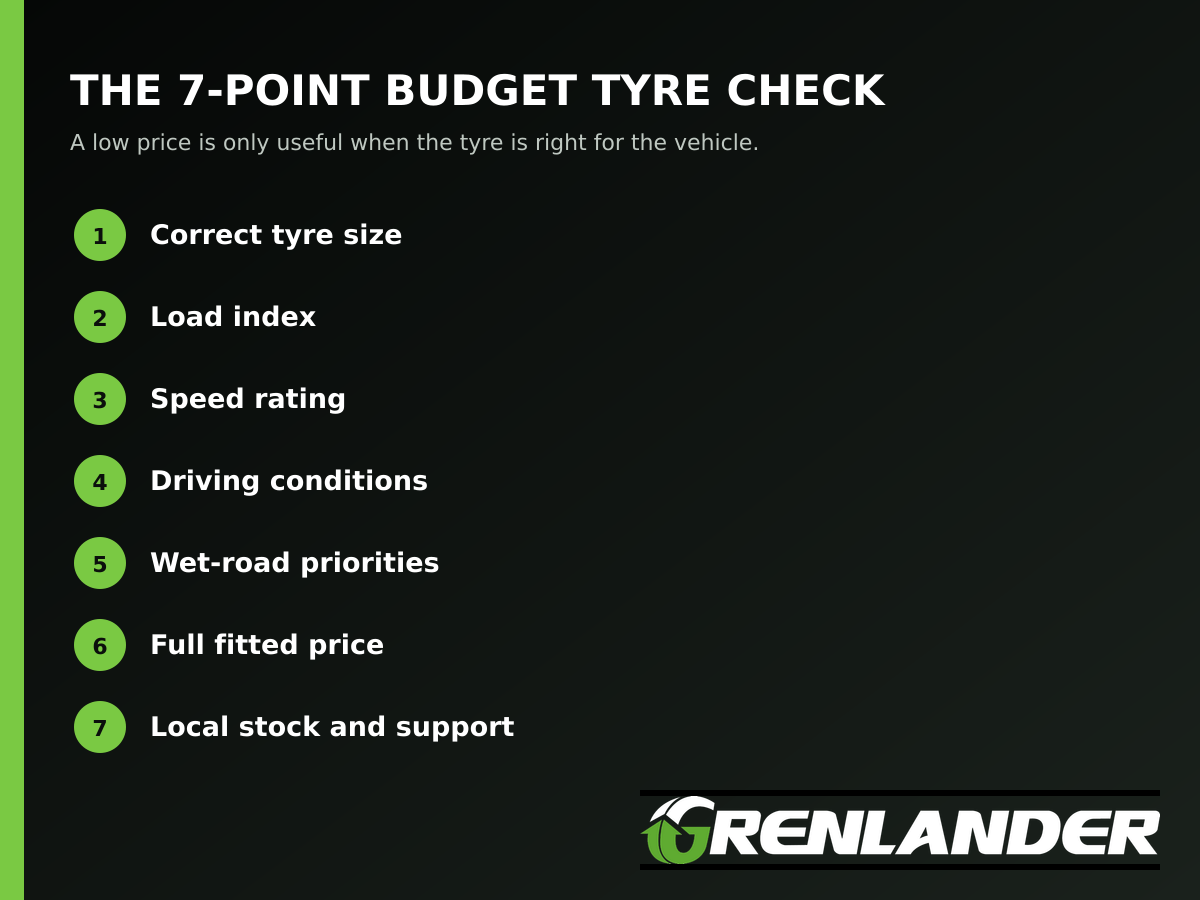
1. Start with the tyre placard
The vehicle’s tyre placard—commonly found inside the driver’s door opening—shows the manufacturer’s tyre and pressure information. The RACV tyre buying guide also advises buyers to start with the placard or existing tyre size before comparing prices and features.
Do not stop at the width and rim diameter. A complete marking such as 205/55R16 91V also includes construction, load index and speed symbol.
2. Match the load index
The load index shows how much weight the tyre is designed to carry under its specified conditions. It is especially important for SUVs, EVs, work vans, towing and vehicles that regularly carry tools or passengers. Do not reduce the required load capability simply to save money.
3. Match the required speed rating
The speed symbol is part of the tyre specification and must suit both the vehicle and the applicable rules. A fitter can confirm whether a different rating is permitted for that vehicle and use case.
4. Choose the tread category for real driving
For a vehicle used mostly on sealed roads, a passenger or highway-terrain pattern is usually more relevant than an aggressive off-road tyre. Regular gravel, worksites or touring may call for an all-terrain design, while commercial vehicles need tyres suited to their load and duty cycle.
Paying for capability you rarely use can add noise, weight or cost without making the daily drive any better.
5. Ask what supports wet-road performance
Look for model-specific information about tread grooves, compound and water evacuation, and treat broad marketing language with care. Where independent comparative data exists for the exact model and size, it is more useful than a claim about an entire brand.
6. Compare the full fitted price
Check whether the quote covers fitting, balancing, valves, disposal fees and any alignment work that is genuinely required. A low tyre-only price may look quite different once the full job is calculated.
7. Check local stock and replacement support
Before buying, ask whether the exact size is held locally and how quickly one replacement could be sourced after damage. Grenlander’s Australian website says the range is distributed from warehouses in Brisbane, Sydney, the Gold Coast and Melbourne. The product pages list the manufacturer’s full size range, so availability still needs to be confirmed.
Budget versus premium: what are you really paying for?
| Decision factor | Budget-focused tyre | Premium-focused tyre |
|---|---|---|
| Purchase price | Usually lower | Usually higher |
| Everyday fitment coverage | Often strong in common sizes | Often strong, sometimes with more vehicle-specific options |
| Maximum wet/dry performance | Varies by exact model and size | May offer a higher performance ceiling, supported by brand investment and testing |
| Noise and ride refinement | Can be suitable for normal use; model dependent | Often receives more development attention, but results still vary |
| Specialist capability | Selected A/T, M/T, commercial or run-flat options | Often broader premium technology or vehicle-specific homologation |
| Best choice for | Drivers who match the tyre carefully to a mainstream use case | Drivers who need or value additional performance, refinement or evidence |
This does not mean one price tier is always good and the other always poor. It means the exact tyre deserves more attention than the category label.
How Grenlander’s range maps to different needs
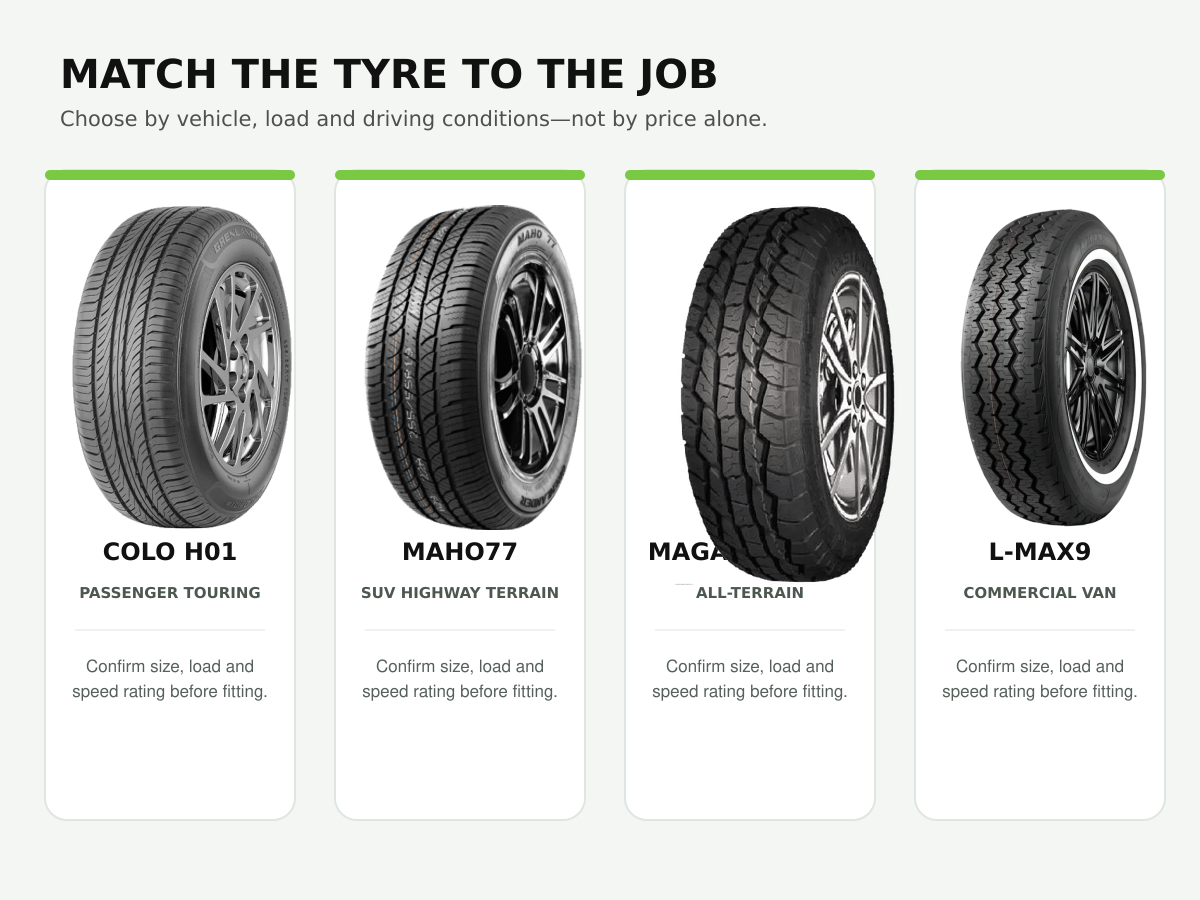
Grenlander’s Australian range page lists 27 tread patterns across passenger, SUV and 4×4, commercial and truck categories. These examples illustrate different applications; they are not universal recommendations:
- COLO H01: a passenger touring pattern. The product page lists 97 manufacturer-range sizes from 145/70R12 to 235/65R17 and describes a silicon-containing compound, variable tread-pitch approach and wet-road focus.
- MAHO77: an SUV highway-terrain pattern. The product page lists 27 manufacturer-range sizes from 215/75R15 to 255/55R19 and describes an all-season, noise-conscious tread with drainage grooves.
- MAGA A/T TWO: an SUV and 4×4 all-terrain pattern. The product page lists 47 manufacturer-range sizes from 175/75R13 to 305/50R20, including passenger and LT specifications, and describes open tread, stone-ejection and zigzag siping features.
- L-MAX9: a commercial van pattern. The product page lists 34 manufacturer-range sizes from 185R14C to 215/60R17C and describes a reinforced carcass and a heavily siped tread intended for load duty and comfort.
Confirm current Australian stock and the exact specification before committing. A tread pattern name by itself does not establish compatibility with a particular vehicle.
Maintenance still decides the outcome
Even the right tyre can become unsafe when pressure, alignment, rotation or tread condition is neglected. NSW roadworthiness guidance says tyres must be in good condition, correctly inflated and have at least 1.5 mm of tread. Victoria’s tyre maintenance guidance also requires at least 1.5 mm in the principal grooves and warns against damage or defects.
Check pressures when the tyres are cold and look for cuts, bulges and uneven wear. Unusual vibration or rapid pressure loss should be investigated. Use the vehicle and tyre manufacturers’ instructions rather than a generic pressure found online.
What matters most
A budget tyre can be a sensible purchase when the exact model is road-legal, correctly specified, suitable for the vehicle’s real work and supported locally. The wrong size, rating or tread type is not good value at any price.
Start with the placard, confirm the load and speed requirements, and match the tread to the roads you actually drive. Then compare the full fitted price and ask about replacement stock. That process is more useful than asking whether all budget tyres are safe.
Frequently asked questions
Are budget tyres safe for highway driving?
Some budget tyres may suit highway use when the exact size, load index and speed rating match the vehicle and the tyre is designed for sealed-road duty. Vehicle load, heat, speed, pressure and condition all matter, so confirm the fitment with a qualified tyre professional.
Are cheap tyres legal in Australia?
Price has no bearing on legality. The tyre and its installation must meet the applicable standards and vehicle requirements, and the tyre must remain roadworthy in service.
Is an all-terrain tyre safer than a highway-terrain tyre?
Not automatically. An A/T pattern may add gravel and off-road capability, while an H/T pattern may be a better match for mainly sealed-road driving. Choose according to where the vehicle is actually used.
How do I know which tyre size my car needs?
Check the tyre placard, owner’s manual and the full marking on the existing tyre. Any proposed change in size or rating should be confirmed with a tyre professional before purchase.
What is the legal minimum tread depth?
NSW and Victorian roadworthiness guidance specifies at least 1.5 mm in the relevant principal tread area. Tread depth is only one part of the condition check; damage, cracking, bulges and other defects can also make a tyre unroadworthy.
Does a more expensive tyre always last longer?
Price alone cannot tell you how long a tyre will last. Wear depends on the exact tyre, compound, vehicle, load, pressure, alignment, rotation, roads and driving style. Compare documented evidence for the exact product and maintain it correctly.
Related guides
- Grenlander Australian tyre range
- Are Grenlander Tyres Good? Australian Buyer’s Guide
- All-Terrain vs Highway-Terrain Tyres
- Contact Grenlander Australia
Sources
- Australian Government — Current Australian Design Rules
- RACV — How to buy the best tyres for your car
- NSW Government — Roadworthiness
- Transport Victoria — Tyre maintenance and repair
- Grenlander Tyres Australia — Full range
- Grenlander product pages linked in the model section above