
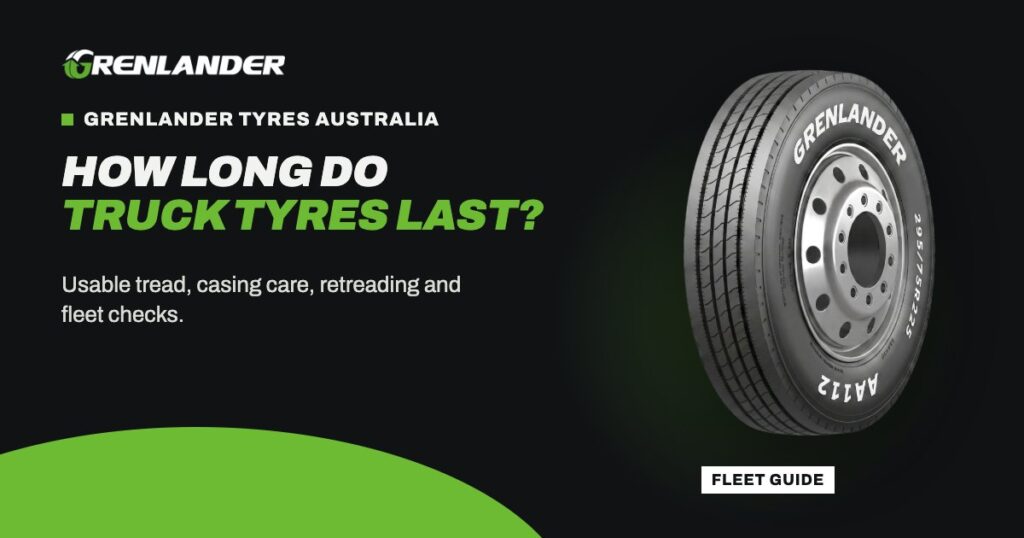
There is no single kilometre figure for how long a truck tyre lasts. A truck tyre’s life is the tread it starts with, less the 1.5 mm legal minimum, worn away at a rate set by wheel position, load, pressure, alignment and route. If the casing is sound, it can then be retreaded for another tread life.
This guide is for tyre shops, workshops and fleet buyers. It covers how to work out the tread you actually have to use, what Australian inspection rules say about worn and retreaded tyres, and the checks that protect a casing. It uses the Grenlander truck range as the worked example.
Start with the tread you can actually use
The National Heavy Vehicle Inspection Manual (NHVIM), Section 5 lists a tyre as a reason for rejection if it does not have at least 1.5 mm of tread depth in the principal groove. That depth must run in a continuous band around the whole circumference and across at least 75% of the tyre’s width. Measure in the principal grooves, where most tyres carry their wear indicators, not in the shallow secondary grooves.
So the usable tread on a new tyre is roughly its new tread depth minus 1.5 mm. Grenlander’s truck specification tables list a new tread depth for every size, which makes the arithmetic easy:
| Pattern | Label on our truck page | Rows listed | Rims | New tread depth (mm) | Above 1.5 mm (mm) |
|---|---|---|---|---|---|
| AA112 | TBR | 13 | 17.5, 19.5, 22.5, 24.5 | 12.5 to 15.3 | 11.0 to 13.8 |
| AD123 | TBR | 5 | 22.5 | 14.5 to 15.0 | 13.0 to 13.5 |
| AD675 | TBR | 2 | 22.5 | 18.5 to 22.0 | 17.0 to 20.5 |
| AD683 | TBR | 1 | 22.5 | 20.0 | 18.5 |
| AD686 | TBR | 5 | 17.5, 22.5 | 17.0 to 20.0 | 15.5 to 18.5 |
| DD678 | TBR | 12 | 17.5, 19.5, 22.5 | 12.5 to 20.0 | 11.0 to 18.5 |
| FT162 | Trailer | 6 | 17.5, 22.5 | 13.5 to 16.5 | 12.0 to 15.0 |
| FT167 | Trailer | 5 | 16, 22.5 | 13.5 to 15.0 | 12.0 to 13.5 |
| TT166 | TBR | 4 | 22.5 | 15.0 | 13.5 |
These figures are manufacturer catalogue values from each product page. They describe a new tyre. They do not predict kilometres. Two tyres with the same depth can wear at very different rates in different jobs, so compare like with like. One 11R22.5 example shows the spread: AA112 lists 14.0 mm, AD123 14.5 mm, and AD683 and AD686 20.0 mm.
What decides how fast the tread goes
For a fleet, the useful question is “what is wearing these tyres faster than the others?” The NHVIM rejection list doubles as a checklist of the conditions that end a tyre’s life early.
Load against the tyre’s rating
The NHVIM rejects any tyre that is not of sufficient size and capacity to carry the axle’s share of the vehicle’s gross mass. Most rows in Grenlander’s truck tables list separate single and dual ratings. For example, the AA112 11R22.5 row lists load indices 148/145, which is 3,150 kg per tyre in single fitment and 2,900 kg per tyre in dual. Check the figure that matches how the tyre is actually fitted.
Pressure
Set pressures from the vehicle or tyre manufacturer’s figure for the load, check them regularly and record them. Look into any tyre that keeps losing pressure rather than just topping it up.
Duals and clearance
Dual tyres must not contact each other, and no tyre may foul the body, chassis or suspension through its range of travel. Both are NHVIM rejection items, and both mark a tyre for closer inspection.
Damage and irregular wear
Deep cuts, exposed wire or cords, chunking, bumps and bulges are listed as signs of carcass failure. If a tyre is wearing unevenly across the tread, check the vehicle as well as the tyre before you fit a replacement.
Wheel position and pattern
Fit the pattern to the position it is meant for. The wheel position for each Grenlander truck model is listed in our truck tyre ordering checklist. Some product pages note that earlier descriptions and imported labels differ, so confirm the position for your exact application before you order.
Casing care: the second life of a truck tyre
The NHVIM defines retreading as reconditioning a worn tyre by topcapping, fullcapping, remoulding or applying a pre-cured tread. The casing is what gets reused, so how the first tread is run decides whether there is a second.
- Pull tyres before damage reaches the casing. The NHVIM lists exposed cords, bumps and bulges as signs of carcass failure. Have the retreader assess any damaged casing before you count on a second life.
- Agree a removal point with your retreader. Ask what remaining tread and casing condition they need before you run a tyre down to the legal minimum.
- Keep repair records. Under the NHVIM, every major repair must be marked with the repairer’s identification and the date of the repair.
- Don’t regroove unless the tyre allows it. Regrooving is a rejection item unless the sidewall says the tyre is suitable for it. On a retread, only tyres marked “REGROOVABLE” may be regrooved.
Grenlander’s product pages don’t state whether a casing is retreadable. Ask about the exact model and size in your enquiry if retreading is part of your fleet plan.
Are retread truck tyres safe?
Retreads are a recognised, regulated part of truck tyre use in Australia. The NHVIM says retreaded tyres must be used in accordance with Australian Standard AS 1973 (retreading and repair processes), and it sets out the marking that standard requires. Whether a particular retread is a sound choice depends on the casing, the retreading process and the job it is fitted to. That is a decision for the fleet and its tyre professional. Your counter staff can still check the markings on any retread that comes through the door:
| Check | What the NHVIM describes |
|---|---|
| Retread marking | “RETREAD” or “REMOULD” on both sidewalls or shoulders. An unmarked retread is a rejection item. |
| Size and rating | On at least one side: nominal size, R for radial, “TUBELESS” if applicable, and the load rating, ply rating or service description. |
| Speed | Truck/bus retreads keep the original speed category. Speed-limited ones have the original speed symbol removed and are marked “max. speed 80km/h” or “speed limited to 80km/h”. |
| Rebelted casings | “REBELTED” if the structural belts have been replaced. |
| Marking quality | New markings in letters at least 4 mm high, permanent and legible, with a week/year date code. |
A simple fleet tyre check
- Measure tread in the principal grooves at several points around the tyre and record it against the tyre’s position and vehicle.
- Compare the reading with the new depth on the product page to estimate how much of the usable tread has gone.
- Check pressure against the specified figure for the load, and refit the valve caps.
- Inspect sidewalls and tread for cuts, exposed cords, bulges and uneven wear, and check the gap between duals.
- On retreads, confirm the markings in the table above.
- Flag any tyre that is wearing faster than others in the same position, and find out why before replacing it with the same thing.
Ordering replacement truck tyres
Keep the whole specification on one line: model, full size, single and dual load indices, speed symbol and ply rating. Add the intended wheel position, quantity and delivery postcode. Our truck tyre ordering checklist shows a worked example, and the load index and speed rating guide explains the codes. Browse the Grenlander truck range, then send a wholesale enquiry with each size on its own line.
Frequently asked questions
How long do truck tyres last?
Until the tread reaches the 1.5 mm minimum in the principal grooves, or until damage ends the tyre sooner. How long that takes depends on the starting tread depth, wheel position, load, pressure and route. A sound casing can then be retreaded.
How many kilometres do truck tyres last?
There is no reliable single figure. The most useful estimate for your fleet comes from your own records: tread depth measured at known kilometres for the same pattern, size and position.
Are retread truck tyres safe?
Retreads must be used in accordance with AS 1973 and marked “RETREAD” or “REMOULD”, with their speed rating shown as the NHVIM describes. Unmarked retreads are rejected at inspection. Whether a given retread suits a job is a call for the fleet and its tyre professional.
How much does a truck tyre weigh?
It depends on the size and construction. Grenlander’s specification tables don’t list tyre weight, so if you need it for freight or handling, ask for it for the exact model and size in your enquiry.
What is the minimum tread depth for truck tyres in Australia?
The NHVIM rejects a tyre without at least 1.5 mm of tread in the principal groove, in a continuous band around the whole circumference and across at least 75% of the tyre’s width.
Tread depths, load figures and labels from the linked Grenlander product pages and truck range page, checked 20 October 2026. Inspection and retread requirements from NHVIM V3.2, Section 5.